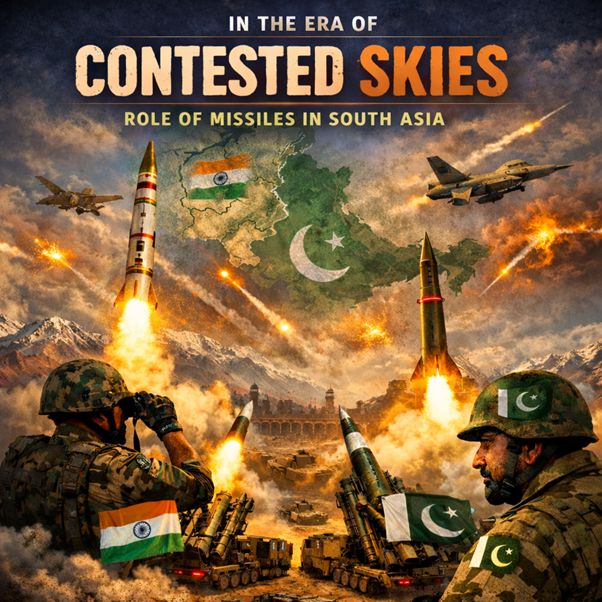
Since the last decade, South Asian military escalations have been dominated by the roars of after burners and dogfights. From 2019 Balakot standoff to the intense 2025 conflict, fighter jets were the primary currency of power. Both Pakistani and Indian air forces have acquired state of the art fighters from China and France respectively since last decade. However, it seems that a significant shift in the use of force is underway. On January 13th, 2026, Indian army chief General Upendra Dwivedi hinted at establishing a “Rocket-cum-missile force.” This semblance of a transition is not happening in vacuum. It follows Pakistan’s establishment of Army Rocket Force Command (ARFC) announced in August 2025, a unified body tasked with operating sophisticated assortment of rocket artillery, cruise missile, and future hypersonic systems. For Pakistan, the ARFC represents a logical next step in its “Full Spectrum Deterrence” posture, amalgamating its conventional capabilities to strike deep under a unified command. This may have signaled that the era of air-dominated escalation may be taking a step back and is to be replaced with precision guided missile salvo.
The push by India towards potential creation of a dedicated rocket force may stem from arduous reality: air parity. In both the 2019 and 2025 escalation, India suffered the loss of fighter aircraft, underlining that even a technologically larger and well-equipped air force faces unacceptable risks when operating in highly contested air environments. During the 2025 crises, Pakistan’s ability to down several Indian fighters demonstrated that the tradeoff for using multi-million dollar jets, potential loss of pilots, to deliver payloads is increasingly becoming an unaffordable gamble.
As General Manoj Pande, the former Indian Chief of Army Staff, said:
"In recent conflicts... we have seen the utilization of long-range missiles, long-range artillery to very good effect. They not only give you longer ranges, but they are also more accurate. I would also suggest that it is more economical."
The economics of war are shifting. Losing a $100 million fighter jet and a highly trained pilot to hit a target that a $1 million precision rocket could have neutralized is no longer a viable strategy in the South Asian theater. As air denial became the new norm during the May 2025 conflict, both Pakistan and India restricted their engagements to standoff weaponry, maintaining a strict distance from the border. Now the side that can saturate and precisely target enemy positions without fear of loss hold strategic advantage.
The shift can be understood from the context of Russian Ukraine war where the dynamics may not be similar, but a comparison could be made. After suffering unsustainable air losses by both sides, especially by a major power like Russia, both sides have now shifted towards “air denial,” where skies remain contested and localized superiority is only achieved during massive drone and missiles barrages. The Russian-Ukraine war has reached a point where the air forces of both sides cannot operate freely but still utilizes their air assets in localized operations like shooting down drones and launching of standoff weapons like cruise missiles. Pakistan has clearly internalized this lesson. By focusing on systems like Fatah series and potential hypersonic systems, Pakistan is building a force designed to “strike from every direction,” as Prime Minister Shehbaz Sharif noted during the inauguration announcement of AFRC.
Indian Army Chief General Dwivedi’s recent statements confirm that New Delhi is now playing catch-up:
“We are looking towards a rocket-missile force because, as you know, Pakistan has established a rocket force, and China has also created such a force. It is the need of the hour that we also establish such a force.”
The push by South Asian countries for the establishment of dedicated rocket force offers a strategic advantage by shifting the cost of engagement towards superfluous hardware rather than human lives. While the loss of missile is merely a setback, the downing of the fighter jet, exemplified by capture and subsequent return of downed Mig-21 of then Wing Commander Abhinandan Varthaman by the Pakistan Air Force in 2019, triggered a national crises and diplomatic liability for India.
On the other hand, the Indian Army Chief’s reference to the People's Liberation Army Rocket Force (PLARF), a strategic force established in 2015 to integrate both conventional and strategic assets, underscores New Delhi’s belated recognition of a paradigm shift towards missile-centric warfare. While Beijing established the blueprint for high intensity, noncontact operations by raising its rocket force to a full-service branch, it is Pakistan’s ARFC that has operationalized the push for this model within the South Asian theatre.
By prioritizing precision guided capabilities, Pakistan maintains a credible conventional deterrent while minimizing the risk of high stakes escalation, this also means Pakistan has a head start from the command point of view. As a country with more financial resources and larger military budget, India may catch up fast albeit only if they make a dedicated rocket-cum missile force.
As the Indian army chief acknowledges the need of the hour, it is conspicuous that Pakistan’s early lead in establishment of unified rocket command has forced a reevaluation in New Delhi’s military doctrine. In the next escalation, the decisive factor may not be who has the better fighter, but who can deliver the most precise, economical and risk-free blows from standoff range. This isn’t to say that air forces have become redundant; the May 2025 conflict suggests that drones may play a more active role in future escalation. However, in the South Asian context, a rocket force may become the most powerful piece of puzzle. Establishment of rocket force by India would present serious repercussions for Pakistan’s calculus due to geography and limited depth.