History is replete with events that have shaped contemporary strategies, and the Battle of Lepanto is one of them. It was a striking event observed and narrated by Miguel de Cervantes. He proclaimed that the battle was “The best day’s work in centuries”. The Battle of Lepanto was a historic event, and it also laid the groundwork for modern naval strategies, encompassing a myriad of factors with a potential for triumph.
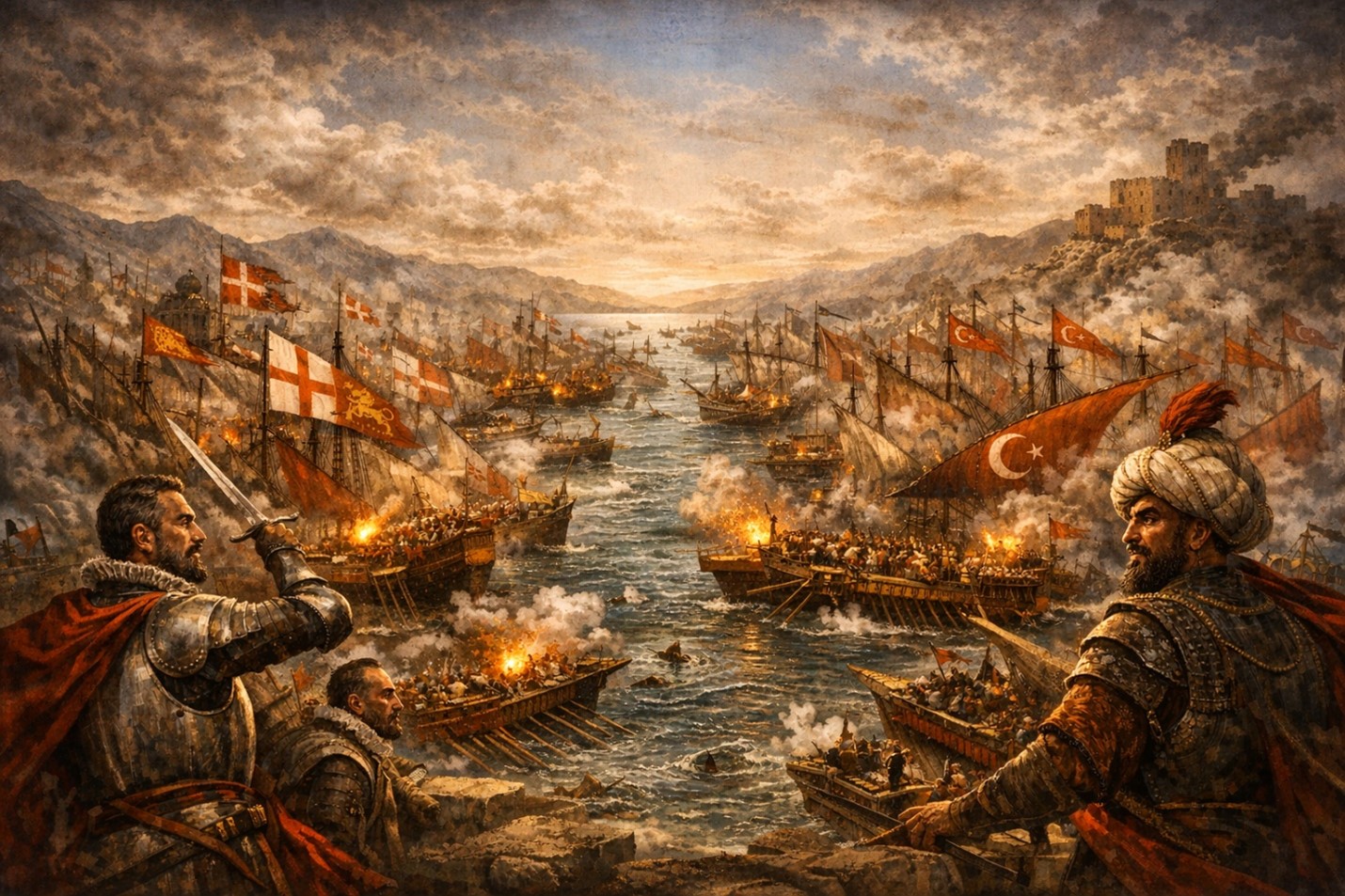
To understand the strategic aptness, it is important to discuss the events of the battle. The battle commenced on Oct 7th, 1571, when the Ottoman fleet met the Holy League in the Gulf of Patras. Ali Pasha commanded the Ottoman fleet under Sultan Selim II. On the other flip side, the Holy League was formed as a result of an alliance of major European States, which was headed by Don Juan of Austria, instituted by Pope Pius V. The expansion of the Ottoman Empire posed a threat to European states, compelling them to form a strong coalition to counter the empire. The Holy League consisted of Spain, the Republic of Venice, and the Papal States.
The alliance was formed to pursue the mutual goal of curbing the growing influence of the Ottoman Empire. The battle was an embodiment of naval strategies from both ends. Moreover, the Battle signaled the largest naval engagement aimed at conquering the Mediterranean Sea, with over 450 ships participating during the battle, along with a wide variety of galleys. The Battle lasted for several hours and resulted in the victory of the Holy League due to its brilliant decision-making and pertinent strategies. The Battle’s significance is shrouded in the defeat of the Ottomans, which was a striking blow to their dominance and influence.
The battle illustrates enduring principles of coalition warfare, unity of command, and concentration of force. The first strategy to consider was the allocation of a leader who was neutral to the interests vested by others. The appointment of an unbiased and inspiring leader was to run the Holy League. This decision was made considering the single codified goal of the alliance, and appointing Don Juan was the best decision, which resulted in the success of the Holy League. Furthermore, the Holy League was well-equipped in terms of its weapons. The naval fleet was redesigned with advanced upgrades and firepower.
On the contrary, the Ottomans resorted to a different approach, by driving a wedge between enemies and maintaining it so that attention is divided in multiple directions, rather than focusing it on one side. This creates chaos and confusion, followed by a trust deficit within the alliance, increasing the proportion of erroneous decisions. This strategy opens the window for an offensive strategy by dismantling the spirit of the opposing force. A Crescent-shaped naval formation of the Ottoman fleet was deployed. The fleet was divided into the right and left wings. Numerous studies show that this format has been widely used in historical warfare as a method to enhance defensive strength and enable the double envelopment of the opposing forces. Furthermore, the double envelopment arrangement created a pincer effect, isolating the opposing force from both sides, restricting their mobility.
While tactical formations moulded the practical battlefield, broader strategic assessments also influenced the events of the war. Another pivotal point is the identification of the hub from where the entire Mediterranean Sea could be seized and enable dominance over the entire Sea. The identification of such a strategic location is important as it adds to the pre-existing strategy, providing a solid foundation for the next course of action.
The strategies employed during the Battle of Lepanto resonate with the Centre of Gravity theory introduced by Carl von Clausewitz. This analogy could be carried out in the following way: the center of gravity is the epicenter of power and movement. The center of gravity of the Holy League was planned and coordinated political cohesion, formulated by Pope Pius V, enabling the integration of a unified operational instrument aiming to dismantle the Ottoman forces. This could have been achieved through the unity of command, which was observed under the Don's leadership. By contrast, the primary center of gravity revolved around the leadership of Ali Pasha, which can be termed the central axis.
The operational center of gravity was grounded in the command authority of Ali Pasha, amalgamated with the psychological aspect of Ottoman dominance and naval strength. The nexus of the center of gravity in terms of the Holy League could be summarized in the following way. The urgent need to create a strong alliance to reinforce political cohesion, with an adequate unified command, concentrated combat power in combating the opposing forces, leading to tactical success of the Holy League. The Ottoman forces relied on centralized command, followed by the loss of the commander after the disintegration of the right and left wings, leading to psychological collapse and resulting in the defeat of the Ottomans.
The battle is full of lessons which are still applicable in the contemporary world. In conclusion, the Battle of Lepanto was more than a standoff between two forces. It was an embodiment of politics and strategic importance. It primarily focused on the political cohesion, unity of command, and the protection of the strategic center of gravity. Modern naval warfare has changed drastically and is more reliant on technological advancements, but the foundational logic can be readily applied from this battle. This battle is enmeshed in how the strategy, leadership and cohesion shape the outcomes of the sea.