Introduction
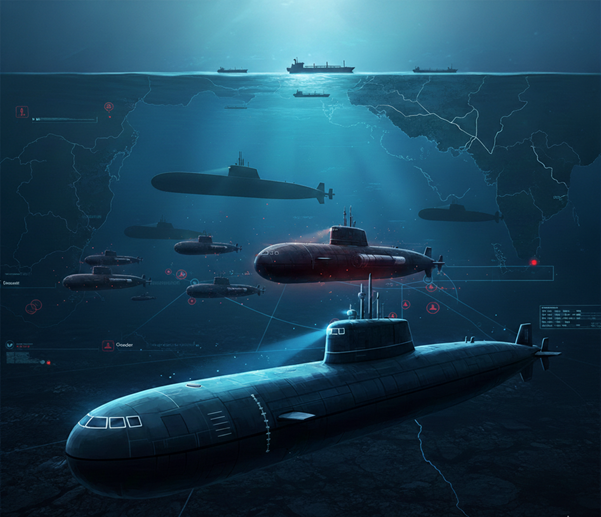
Several decades of naval confrontation between India and Pakistan were characterized by relative equality on the surface, which was marked by the use of diesel-electric submarines by both countries. Nonetheless, the AUKUS (Australia-UK-US) agreement has paved the way to a Pandora box of transfers of nuclear propulsion on ships. In the case of India getting a similar agreement, based on Western (probably American or French) modular reactors and acoustic silencing technology, it would upset the fragile strategic balance in the South Asian region. To Pakistan, this is not just modernization of the Indian Navy; this is a step towards Indian maritime hegemony that poses a threat to the Indian maritime hegemony to the Pakistani doctrine of Sea Denial, its economic survival, and sustainability of its nuclear deterrent.
The Erosion of Sea Denial and the Tactical Imbalance
Sea Denial has been the main idea of the maritime military doctrine in Pakistan. As it realized that the Indian Navy had numerical strength, the Pakistan Navy (PN) has long been investing in the high quality of conventional diesel-electric submarines in order to establish a no-go zone for Indian surface vessels. It is presently led by the Agosta-90B type and the purchase of eight Type 039B Hangor-class with Air-Independent Propulsion (AIP). Yet, an Indian SSN fleet, enhanced by the western stealth and reactor technologies, would essentially cancel out such an advantage. As opposed to traditional submarines that have a battery life and require the boat to surface and snorkel (to use diesel engines), an SSN is capable of staying underwater for months. Indian SSNs would be used as apex predators in a conflict, that is, they would be focused specifically on Pakistani conventional submarines. The higher acoustic silencing of the Western-designed reactors would supposedly enable the Indian SSNs to detect the PN submarines prior to their own detection. Analysts at the International Institute for Strategic Studies (IISS) believe that the deployment of high-end SSNs provides an unparalleled permanence to the sea-deniability capabilities of the conventional navies, and that, as such, the resources of the Pakistani sea-deniability are transformed into a resource targeted instead of an asset capable of targeting.
Strategic Vulnerability of Sea Lines of Communication (SLOCs)
The economic survival of Pakistan is closely associated with the North Arabian Sea. Almost all its imports encompass its trade, and almost all its oil imports come through the ports of Karachi, Bin Qasim, and Gwadar. The country is very vulnerable to a naval blockade. AUKUS-style agreement would result in AUKUS-like endurance to India, which it cannot sustain. Whereas the current Indian fleet is in need of regular port calls or tendering, the Western SSNs are made to travel long distances at high speed. The implication of this is that a Distant Blockade is possible. Indian SSNs would be able to occupy the Persian Gulf chokepoints (Strait of Hormuz) or the Gulf of Aden, where they will intercept Pakistan-bound tankers many thousands of miles offshore of Pakistani coastal defenses. This puts the Pakistan Navy in a kind of dilemma: it is unable to defend its merchant shipping, which is this far out of its base, but it will not survive an economic closure. Moreover, the pace of an SSN (usually over 30 knots underwater) enables it to rearrange throughout the performance of arms much quicker than any Pakistani ship, providing India with maneuver dominion. According to Naval Technology, an SSN has a high tactical speed, which permits it to declare the place and time of an engagement.
The Compromise of the Second-Strike Capability
The implication that affects the stability of the nuclear deterrent in South Asia is most critical. The full spectrum Deterrence of Pakistan is based on a believable second-strike capability, which is institutionalized through the Babur-3 Submarine-Launched Cruise Missile (SLCM). The reason why a sea-based deterrent logic is founded on invulnerability is the concept that a submarine cannot be detected and destroyed during a first strike. But the entry of a new generation of SSN with Western sonar suites (as carried by the Virginia or Astute classes) is a direct challenge to this survivability. Once Indian SSNs can trail Pakistani submarines upon their exit port, which was employed during the Cold War, Pakistan nuclear armed submarines will become targets of a preemptive counterforce attack. This puts pressure on Islamabad to use it or lose it. In case Pakistan feels that its oceanic resources are being monitored using advanced technology, then it might need to hand over the launching powers, as the chances of an unwanted escalation are high. This change nullifies the Stability-Instability Paradox in which technological disparity at sea may encourage Indian strategists to think about aggressive attack, and they can neutralize the options of retaliation by Pakistan.
Coercive Modernization and the Economic-Military Stress
The acquisition of SSN technology would result in the initiation of a massive and non-linear arms race in India. Pakistan would have to react in order to establish the equilibrium, and it could result in an even stronger military-technological reliance on China. This may take the form of a Pak-AUKUS equivalent wherein Islamabad would want Chinese nuclear propulsion technology, which Beijing has historically been reluctant to give away, but may rethink doing so in case the local power balance becomes excessively skewed. In addition to hardware, Pakistan would have to spend billions on the Integrated Undersea Surveillance Systems (IUSS), which involves seabed sensors and drones called Gliders to detect quiet SSNs. The financial cost would be huge. To a nation that is struggling with economic handicaps, the need to keep up with the multi-billion-dollar SSN program in India would mean a drainage of the resources to other vital areas. To counter the Indian SSN threat at a cheaper rate, Pakistan would probably resort to asymmetric solutions, which include swarms of Unmanned Underwater Vehicles (UUVs) and artificial intelligence-driven maritime surveillance resources, but the base drawback of speed and perseverance would still exist.
Erosion of Non-Proliferation Norms and Diplomatic Precedents
India would face serious diplomatic consequences of an AUKUS-type agreement, because it would include the sale of sophisticated naval reactors to non-signatories of the Nuclear Non-Proliferation Treaty (NPT). Pakistan has traditionally promoted a strategic restraint regime in South Asia. If India is offered such a deal, then Pakistan would find it easy to complain in the United Nations and the IAEA that the "naval propulsion loophole" is being used to destabilize the region. This agreement would have marked the close of the zone of parity in the Indo-Pacific. Pakistan will tend to move its diplomatic agenda towards establishing a maritime alliance with other regional powers that fear Indian dominance, possibly through further naval alliances with Turkey and the Gulf countries. Nevertheless, such a precedent established by AUKUS, that the strategic interests may prevail over the traditional non-proliferation norms, would leave no other option to Pakistan except to request the same exemptions, leaving a normative vacuum within the South Asian security.
Conclusion
The supply of SSN technology into India, on the model of AUKUS, is going to be a black swan event in the national security of Pakistan. It would turn the North Arabian Sea into a battleground and leave India with superior waters by a large margin. In the case of Pakistan, the answer cannot be completely symmetric; astronomical prices of nuclear submarines mean that the asymmetric warfare in the navy should be focused, the ISR (Intelligence, Surveillance, and Reconnaissance) must be strengthened, and the partnership with China should be reinforced. Finally, this kind of deal would bring the region closer to a more unstable nuclear posture. The more the Silk Road part of Pakistan is opening up to the eyes of the Indian readers, the closer to war readiness the threshold can be, and the more dependent war readiness can be on the ability to blast off in a second. To the Pakistan Navy, the dilemma in the next decade will be to hold on to a credible minimum deterrent in a period where the hunter-killer powered by nuclear energy but silent will become the new face of the Indian naval power.