INTRODUCTION:
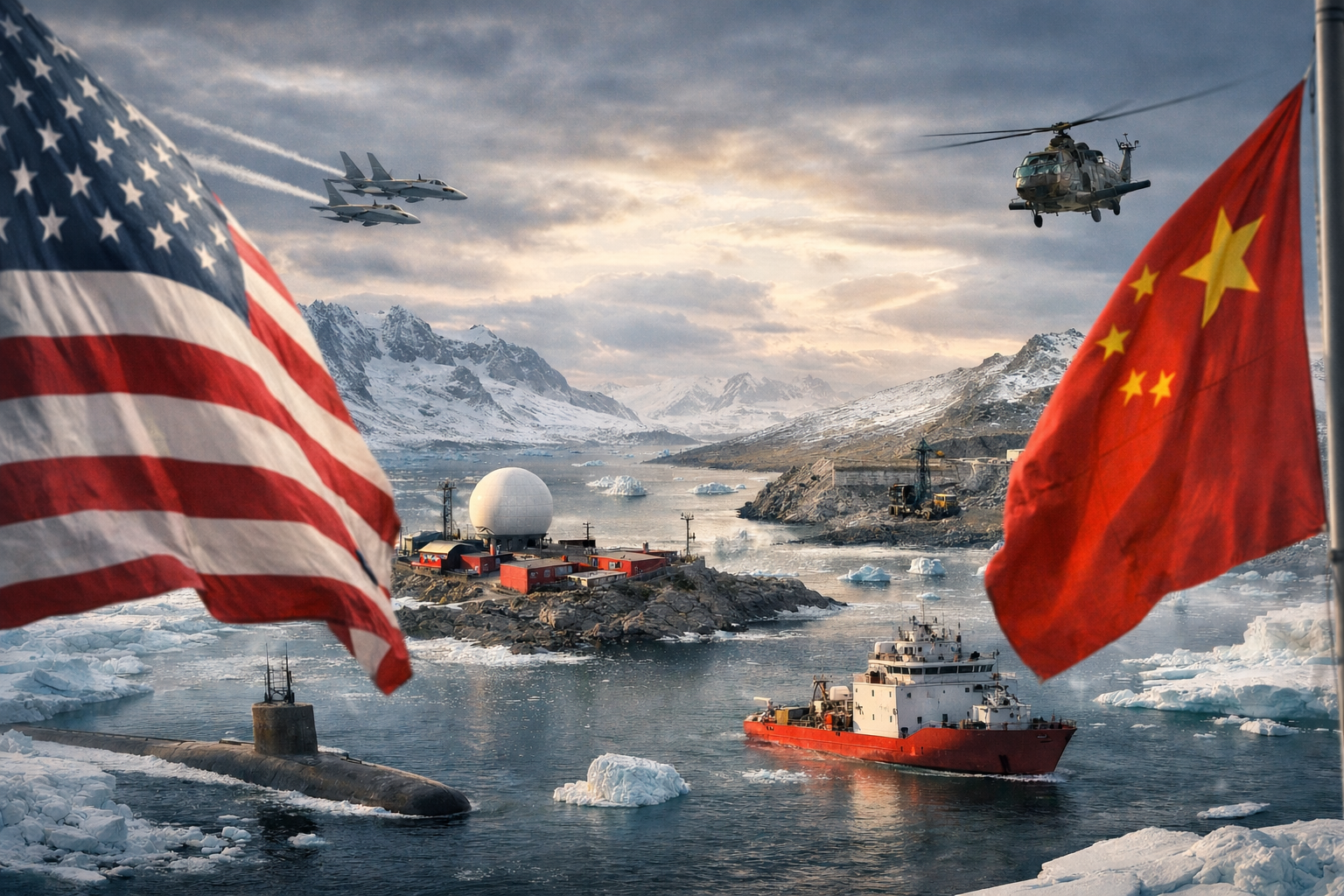
Climate-induced changes in the Arctic have significantly increased the Greenland’s geopolitical, geo-economic and geo-strategic importance for the major powers, particularly US and China. As new shipping routes and access to critical resources emerge, both the US and China have intensified their engagement with the island. This has turned Greenland into a key arena of great power competition, reflecting a race for influence, security, technological and economic advantage in the Arctic.
CHANGING ARCTIC DYNAMICS AND GREENLAND'S ROLE:
The Arctic, once geopolitically a peaceful region post-cold war, is now significantly changing due to ice melting from rising temperatures, leading to potential emergence of new shipping routes, particularly through Greenland. Greenland is strategically positioned between the Northwest Passage and the Transpolar Sea Route, potentially reducing shipping times and providing alternatives to old chokepoints like the Suez and Panama Canals. Consequently, major powers, particularly US and China, are increasingly vying for strategic influence. Despite gaining self-governance from Denmark in 1979 and having autonomy over its resources through 2009 referendum, Greenland’s defense & foreign policy remain largely under Danish control, balancing local governance with global interests.
GREENLAND AND RESOURCE WEALTH:
Controlling newly accessible waters of the Arctic region, particularly around the Greenland is essential for economic development and diversifying supply chains of rare earth metals, since these regions are opening access to enormous natural resources that were previously hidden beneath the ice. Fisheries as well as rare earth elements (REEs) including zinc, iron, copper, nickel, cobalt, uranium, lithium etc. are among of the Greenland’s vital resources. These REEs are essential for technological and military applications. For example, the Amitsoq graphite, a EU-backed project in Southern Greenland, makes a substantial contribution to the manufacturing of lithium-ion batteries.
US GREENLAND’S STRATEGY:
Greenland is of great interest for the US, recognized since 1860s by President Andrew Johnson. In 1946, Harry Truman offered Denmark $100M in gold to purchase Greenland, which was rejected, though a US air base was created in Thule in 1951. This base, crucial during the Cold War, remains active today enabling US to navigate commercial sea routes and counter growing Sino-Russian cooperation. In 2019, Trump’s government attempted to buy Greenland, an offer Denmark rejected, again showing similar interests during second-term in 2025 amidst rising China’s presence in the region. Island’s PM claims that Greenland is not for sale, while Trump argues that “ownership and control of Greenland is an absolute necessity”. Such events offer insights into contemporary Arctic geopolitics.
DEFENSE AND SECURITY GOALS:
Greenland houses Pituffik Space Base, previously called Thule Air Base, crucial for US missiles early warning, defense, environmental and space monitoring. Additionally, Greenland is situated in GIUK Gap (Greenland-Iceland-United Kingdom), essential for an anti-submarine warfare during the Cold War and crucial for surveillance of China’s due-use and Russia’s naval activities in the North Atlantic and Arctic Ocean. Furthermore, US uses the “LC-130”, its sole ski-quipped aircraft to deliver supplies and researchers across Greenland. Under Trump’s 2025 “Golden Dome” initiative, a contemporary resurgence of Ronald Reagan’s Strategic Defense Initiative, an increase in site access and capabilities may be requested to enhance North America's defense against hypersonic missiles.
MILITARY AND TECHNOLOGICAL DOMINANCE:
China has demonstrated a strong stake in Greenland's vast reserves, by funding mining initiatives and attempting to get sustainable supplies. This has caused concern in the USA, where strategists see China's expanding presence in the Arctic as a risk to country’s national security. In order to prevent China from getting accessibility to these resources and guarantee that US retains control over the vital REEs required for maintaining its technological and military superiority, Trump's ambition to purchase Greenland can be interpreted as a preventative action.
RESOURCE CONTROL, REEs AND DIVERSIFICATION OF SUPPLY CHAINS:
China has considerable influence in the international market since it controls around 60% of the world’s supply of rare earth elements (REEs) as well as other essential materials. Elon Musk, the CEO of Tesla and other US manufacturers have expressed concern about the disruption of supply chains caused by Trump’s restrictions on Chinese imports, particularly graphite, a crucial component of lithium-ion batteries. By focusing on Greenland’s mineral resources, the United States wish to establish an alternative supply chain that bypasses China, enhancing its economic and technological self-reliance. The US sees the country as a chance to strengthen economic security, lessen vulnerabilities and contain China’s dominance over these vital resources because China now controls the supply chain of REEs.
CHINA’S POLAR SILK ROAD: GREENLAND AMBITIONS
In 2018, China announced plans to become a “Polar great power” by 2030. It released a white paper outlining its Arctic policy, claiming itself as a “near-Arctic state”. Greenland has been designated as a key location on its Polar Silk Road (PSR) for the time being. The northern pathway would offer a much-needed substitute for the Strait of Malacca, cutting transit time between ports of Asia and Europe by roughly one week. With its unique and careful approach, the country has primarily concentrated on extracting resources. Moreover, Greenlanders have an alternative to total reliance on Denmark due to Chinese funds, which further supports the country's nationalistic aspirations.
RESOURCE AQUIREMENT:
In 2012, Chinese Minister of Land and Resources Xu Shaoshi proposed to make a coalition of nations that produce rare earth metals which marked the beginning of Greenland diplomatic relations with China. China’s involvement included a joint venture between Shenghe Resources and Greenland Minerals and Energy for uranium and rare-earth projects as well as NFC’s minority interest in the Kvanejfeld mine in Southern Greenland. Indeed, mines such as that at Kvanejfeld could be an opportunity for Beijing to consolidate its rare earths monopoly. In addition, several Chinese companies were previously involved in exploring for gold in Illoqortormiut, while General Nice Group had been working on the Isua Iron ore project. Furthermore, due to abundant fish resources, which are getting easier to acquire as a result of climate change, China has a major stake in the region, aiming to ensure food supplies. Therefore, China has seen a significant surge in seafood imports from Greenland, fueled by domestic demand that is expected to outstrip local output by 2030.
INFRASTRUCTURE DEVELOPMENT:
One of the primary element supporting China’s influence in Greenland is infrastructure development. As early as 2012, this was evident in a number of discussions between Greenland’s officials and China’s investors. Furthermore, during a visit to China in 2015, Minister Qujaukitsoq gave representatives from Sinohydro, China State Construction Engineering and China Harbour Engineering an overview of Greenland’s plan for infrastructural development, which included airports, hydraulic and mining projects. This was an blatant indication of China’s ongoing interest in investing in the country. Additionally, China tried to obtain an older Danish naval base in 2016 but USA blocked it, apparently claiming that it will invest in these projects rather than China. In terms of GDP, Greenland currently attract the greatest amounts of Chinese investment among all the Arctic states.
DUAL-USE RESEARCH:
China has significantly invested in research stations, indicates its intent to lead in the region, which enhance polar research capabilities to address climate change. These stations also supports China’s civil-military “BeiDou-2” satellite navigational system. In line with these ambitions, a notable plan includes establishing a research station in Greenland, following a 2016 agreement with the Greenlandic ministry. Therefore, China’s Arctic actions aim not only at resource gain but also to strengthen its influence in global environment governance, particularly in climate change's research and policy making, posing a challenge to current US leadership in environmental governance.
INTERNAL AND EXTERNAL CHALLENGES TO CHINESE ACTIVITIES:
China’s efforts to gain foothold in Greenland and the Arctic are getting strong opposition from the US which perceives these actions as a threat to its strategic interests and aims to secure its dominance. America has actively blocked China’s activities through pressurizing diplomatically and funding projects to counter Chinese investments. To bolster its presence, the US reopened its consulate in Nuuk in 2020, invested billions of dollars in military infrastructure, including modernization of Pituffik Space Base. Moreover, US also conducts joint military exercises, e.g. Arctic Edge 2025 to monitor Chinese movements and maintain its military dominance, emphasizing its ambition to project power in the region. On the other hand, Greenland revoked mining licenses of Chinese companies, banning mining because General Nice’s Iron ore and Shenghe Recourse’s Rare Earth venture’s projects stalled or ended without production. Furthermore, Denmark also vetoed Chinese bid for infrastructure, such as a naval base in 2016 and airports in 2018, reinforcing barriers. No major Chinese mining projects have been materialized in 2025 due to geopolitical risks.
CONCLUSION:
The melting of Arctic ice has created new chances for commercial activities, extracting resources and international influence, which has increased Greenland’s geopolitical relevance. The US, which wants to preserve its superiority in the area, has opposed China’s ambitions to gain a foothold in Greenland. A new phase of great power rivalry having significant ramifications for the Arctic and the beyond is set in motion by continuous competition between US and China.