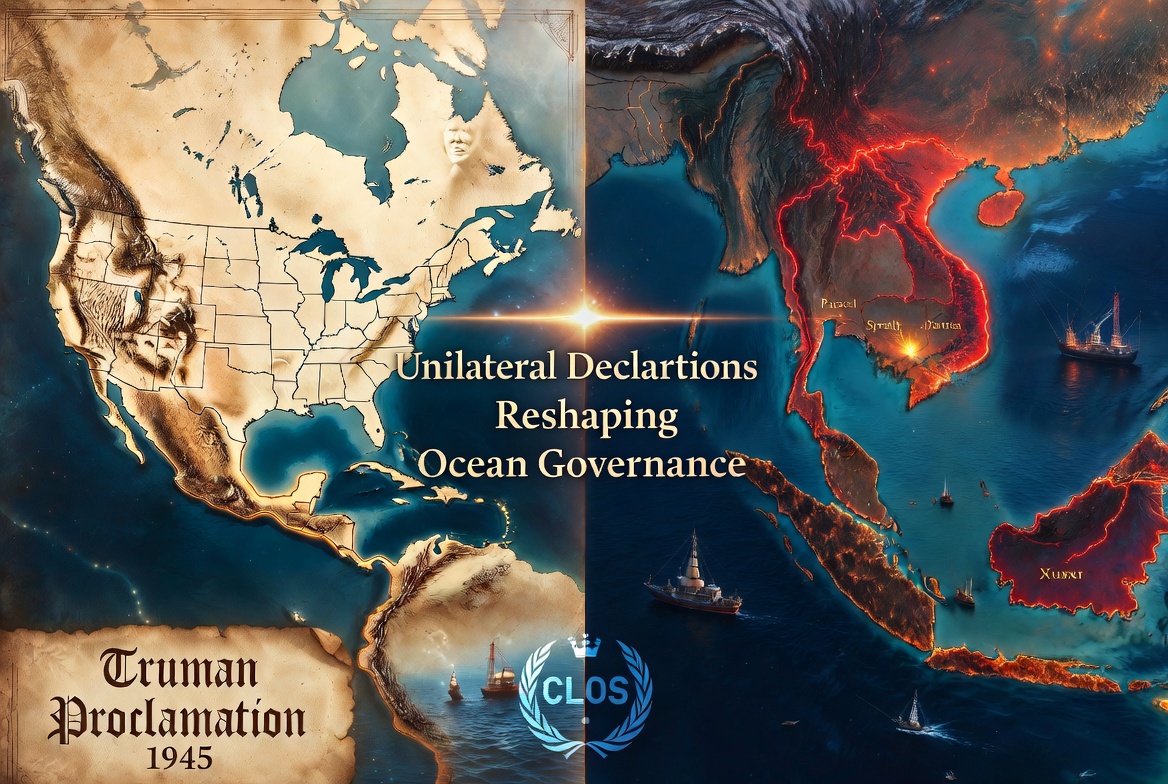
The extension of the coastal State jurisdiction to the ‘continental shelf’ as provided under the United Nations Convention on Law of the Sea (UNCLOS) is greatly influenced by the ‘Truman Proclamation’.From a policy perspective, the US has long faced challenges from several States in the Atlantic and Pacific Oceans claiming continental shelves under this so-called proclamation. Wherefore, in principle, the exercise of jurisdiction over the resources of the continental shelf by the coastal States is reasonable, and in case of dispute, cooperation becomes necessary. Although the US-China relationship contains elements of rivalry over disputed maritime areas, the US view on UNCLOS (based on Truman’s Proclamation) can be equated with China’s position in the South China Sea. In the midst of these developments, the nine-dashed line as a historic claim reiterating China's sovereignty over the islands in the South China Sea, also reflects a reasonable approach to the growing clamour among the States for the continental shelf following the Truman proclamation. Given the above, the Truman Proclamation and the Nine-Dash Line share a common origin as unilateral declarations that sought to expand a state’s reach over the ocean beyond traditional limits. Even assuming hypothetically that China’s claims in the South China Sea became known by the end of the 19th Century, any contention of any competing State in the region never arose before, which strengthens China’s claim. Moreover, China’s historical claim can be further reinforced by evidence that it was the first state to discover and occupy almost all the South China Sea islands. Therefore, compared to established modes of acquiring seas, the influential and technically advanced States like China and the US transform the complementary nature of the law of the sea, which is simple to see but complicated to implement. Although it can potentially be established through common knowledge of the continental shelf that the ocean governance is still evolving, the principles governing ‘freedom of navigation’ appear to remain intact. As mentioned above, both the US and China are maneuverers of the law of the sea through their initial acts of taking possession, and, in modern times, when other states react, they are considering new modes of claiming. Although such theories will be developed with the passage of time, the differentiation of an area of the sea will remain subject to the territorial sovereignty of the coastal state. As the most significant effect of historical claims will be subject to the ‘freedom of navigation’ and ‘exploitation of resources’ in disputed seas, it will also indicate ownership and sphere of influence on maritime zones established under the law of the sea. In this connection, the form of occupation as a symbolic annexation may also play a role in other maritime disputes. As influential states, China and the US can use their persuasive powers to entice their counterparts to reach agreements as proposed by the law of the sea (to settle the dispute peacefully). Of course, it must also be noted that, as a rule of international law, a convention interpreted or a situation or an act must be appraised in the light of the rules as they were when the act was materialised. The doctrines are part of an inquiry into a situation that arose potentially when any state's particular interests continue into the present, albeit in evolved time and space or circumstances. After examining the nature and scope of the nine-dash line and the Trumans’ proclamation, attention should now be turned to a brief discussion of several legal issues associated with the sea and their continuing relevance to the situation in the law of the sea.
Truman Proclamation and the South China Sea