Introduction
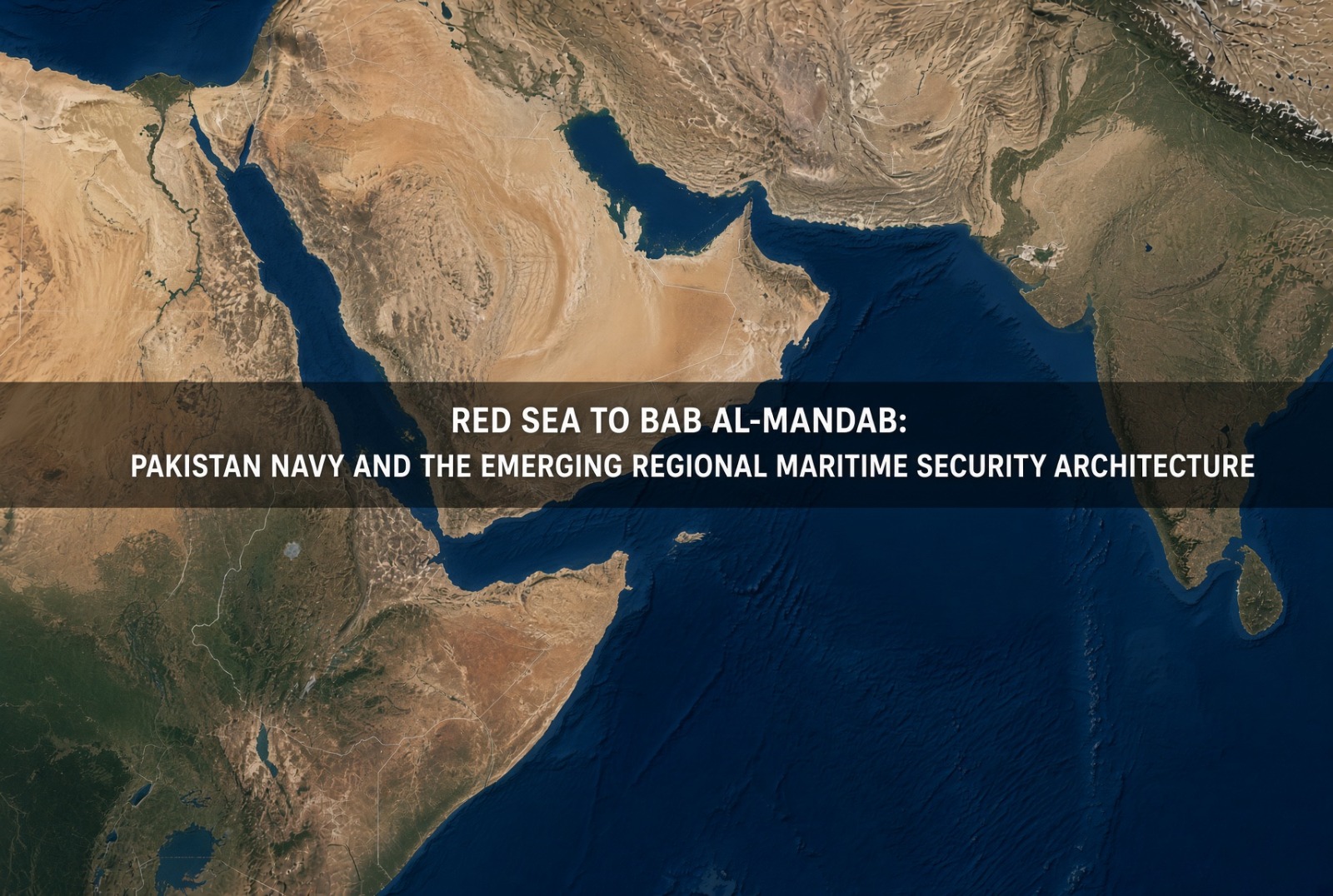
The security situation in the Red Sea can no longer be regarded as a separate aspect of the conflict in Yemen. The fighting in that country has gradually linked a local political issue with the security of commercial shipping, the transport of energy, strategic chokepoints and global supply chains. The Bab al-Mandab Strait is at the heart of this connection. If there is prolonged insecurity in that area, it will have an impact on the maritime link between the Indian Ocean, the Red Sea and the Suez Canal. For Pakistan, this is a matter of direct national concern since the country's foreign trade, its energy needs, its seafarers and its future maritime aspirations all depend on reliable sea lines of communication.
This transforming security environment highlights the growing importance of the Saudi-led Multinational Maritime Defense Coalition (MMDC) which was established on 30 July 2026. Its significance extends beyond the formation of another maritime security grouping; rather, it reflects an emerging effort by states directly affected by regional instability to assume a greater role in regional maritime security. Pakistan's involvement, together with the appointment of a Pakistani officer as Deputy Commander, reflects that Pakistan is taking gradually a pivotal placement within the broader regional security architecture.
From the Yemen Conflict to a Maritime Crisis
The current conflict can be traced back to Yemen's prolonged political crisis. The Houthi movement emerged from the political and social tensions in northern Yemen and transformed into a significant militant force after taking control of Sana'a in 2014. In 2015, Saudi Arabia took military action in support of the internationally recognised government of Yemen with the aim of preventing the expansion of a hostile armed movement along the Kingdom's southern flank. What started as an internal crisis has since escalated into a broader regional conflict with global ramifications.
However, it is important to differentiate between Iranian support for the Houthis and direct Iranian command or control over the movement. While Iran has provided the Houthis with significant military and technical assistance, the Houthis still retain their own political objectives and strategic interests within Yemen. The current crisis can therefore be seen as the result of the interaction of a number of interests: the Houthis aim to maintain and extend their position in Yemen, Iran seeks to expand its influence in the region, Saudi Arabia wants to sustain its leverage and ensure national security, and the international community desires sustenance of safe navigation through the Red Sea.
Israel’s invasion on Gaza and subsequent eruption of conflict in the Middle East have caused ripple effects in the maritime domain also. As the security situation deteriorated in the Yemen, Houthis resumed attacks on commercial shipping transiting Bab-el Mandeb.
The declaration of a maritime blockade against Saudi shipping in July 2026 further added a direct Saudi element to the crisis. The issue was therefore no longer confined to territorial limitations of Yemen, it had also escalated into a broader struggle over the ability to disrupt commercial shipping and generate insecurity along one of the world’s most strategically important maritime passages.
Why Bab al-Mandab Matters
The Bab el-Mandeb Strait, meaning “Gate of Tears,” is a strategically vital maritime chokepoint between Yemen and Djibouti and Eritrea, connecting the Red Sea with the Gulf of Aden and the wider Indian Ocean. At its narrowest point, the 29-km-wide strait is divided into two shipping channels by Perim Island, making control of the island and surrounding coastline particularly important. The strait of Bab al-Mandab connects the Red Sea with the Gulf of Aden and is part of the sea route that links the Indian Ocean with the Mediterranean Sea via Suez Canal to access European markets. Any disruption across this strait compels shipping to adopt an alternative route of Gulf of Good Hope located at the Southern tip of Africa, leading to longer voyage, delays in supplies and higher insurance premiums.
Saudi Arabia also regards the Red Sea from the point of view of national energy and economic interests. The Kingdom is deeply interested in ensuring the security of its western sea routes and in maintaining reliable avenues for exporting its goods. For Pakistan, any disruption in the Red Sea could result in longer journeys, greater freight charges, pressure on its energy supplies and broader impacts on trade. That is the reason why a situation which starts near Yemen can in the end become relevant to Pakistan's national economic security.
What justification is there for a new regional security arrangement?
When looking at the establishment of the MMDC, one should also consider the experience of previous multinational efforts. After the intensity of the attacks on commercial ships in the Red Sea, the United States launched Operation Prosperity Guardian in December 2023 to protect shipping from attacks and launch retaliatory strikes within Yemen against Houthis. The European Union also initiated Operation ASPIDES as a defensive maritime-security operation to safeguard shipping transiting the strait. Experience from these arrangements has shown that forces from outside the region and coming from different countries can help ensure that the sea routes remain open, but the ongoing crisis has also raised a strategic issue: how much responsibility should the countries in the region take on themselves for the security of their regional waters?
The formation of the MMDC marks a significant step in this regard. It must not be seen as replacement of the United States, the European Union, the Combined Maritime Forces or other existing partnerships. What sets it apart is the element of regional ownership. Those states which have direct economic, geographic or security interests in the Red Sea, the Gulf of Aden and the adjacent sea lanes are looking for a means by which they can collectively contribute to the protection of those interests. Indeed, in this respect, the coalition illustrates a wider trend away from reliance on external security providers towards a more layered system in which regional states have a greater say and sense of responsibility.
The Saudi-led Multinational Maritime Defense Coalition (MMDC)
The international meeting of Saudi Arabia's maritime-defence initiative took place in Riyadh on 30 July 2026, with representatives from 43 countries attending together with an EU delegation. A joint declaration in support of the creation of the multinational maritime defence alliance was signed by fourteen states: Saudi Arabia, Kuwait, Bahrain, Qatar, Pakistan, Türkiye, Egypt, Jordan, Yemen, Bangladesh, Nigeria, Sudan, Djibouti and Somalia. After that, the coalition's command structure was established and Rear Admiral Abdullah bin Salem Alshehri was named Commander of MMDC.
The establishment of the coalition and Pakistan’s participation in its founding framework have regional as well as broader implications in the IOR. India has increasingly presented itself as a net security provider in the region. However, establishment of such multilateral defence coalition and exclusion of India nullifies New Delhi’s narrative. This coalition demonstrates that regional maritime security is not the preserve of a single regional actor.
The Tihamah Incident: From Strategy to Human Cost
The attack on the commercial ship Tihamah on 11 August 2026 showcased the direct human and national-security implications of the Red Sea crisis for Pakistan. Three Pakistani nationals were reportedly killed in the attack. The attack changed what had largely been viewed as a general debate over maritime security and the protection of sea lanes into a matter of national concern. The incident highlighted that instability in strategically distant waters can have direct consequences for Pakistan
The Foreign Office of Pakistan denounced the threats against commercial shipping and stressed the importance of freedom of navigation and maritime security. This stance is in accordance with its national interest, since for Pakistan the protection of international sea routes is linked with the continuity of trade and energy supplies, and subsequent economic progression. That is why the MMDC offers the Pakistan Navy a means of turning its diplomatic position into actual maritime cooperation.
A New Phase of Regional Maritime Responsibility
Before the establishment of the MMDC there have been a number of multinational maritime coalitions and task forces. The importance of the current initiative, however, is distinct. The U.S.-led action in 2023 and the European Union's later defensive maritime operation demonstrated the ongoing role of external security providers. The new arrangement led by Saudi Arabia also includes a more substantial regional element since the nations directly affected by the security of these waters are now arranging, coordinating and protecting their interests by means of a common regional structure.
This by no means suggest that regional powers should or can function without international partners, since maritime security is essentially a cooperative matter. A more realistic approach is one involving a layered structure in which regional coalitions, existing multinational task forces and international organizations support and complement each other. The MMDC can thus act as an extra pillar of maritime security instead of becoming a competitor to the existing mechanisms.
Pakistan occupies a favourable placement within this context. Its geographical position grants it a natural link with the Gulf and the Indian Ocean. The geopolitical aspect is further augmented by Pakistan’s longstanding defence relations with Saudi Arabia and Türkiye, as well as its extensive experience in participating in and commanding multinational naval forces, which contributes to its operational credibility in collaborative maritime security initiatives. Although the Makkah Joint Defence Agreement between Pakistan, Saudi Arabia and Türkiye offers an extra strategic background, the MMDC is still a separate multilateral maritime arrangement.
Implications for Pakistan and Pakistan Navy
The Deputy Commander position should be seen as an operational commitment not merely as an honour. The Pakistan Navy can make its contribution by providing maritime-domain awareness, sharing information, carrying out operational planning, acting as a liaison, offering training, conducting exercises and integrating multinational procedures. The more significant long-term chance is to assist in building interoperability before a major crisis arises. If common procedures are established, reliable exchange of information takes place and professional relationships are developed, the time needed by a coalition to respond when maritime security worsens can be reduced.
At the national level, the importance is just as great. Secure sea routes are a necessity for Pakistan in order to ensure its energy security, support its external trade, promote development of port infrastructure and enable future growth in the blue economy. A stable maritime environment stretching from the Arabian Sea through to the Gulf and the Red Sea therefore corresponds directly with Pakistani interests. Moreover, Pakistan's participation in the MMDC can enhance the Pakistan Navy's position as a reliable regional partner in maritime security and give it valuable experience in a security situation that is increasingly connecting the Indian Ocean with the Red Sea.
For the Pakistan Navy the role is therefore wider than that of guarding the nation's coastline; it also involves helping to maintain the marine environment upon which Pakistan's prosperity is based.
Conclusion
The formation of the Saudi-led Multinational Maritime Defense Coalition represents a significant development in the regional maritime-security framework. The fact that the coalition has come about shows that the strategic situation has changed so that the security of Yemen, the Bab al-Mandab, the Red Sea, the Gulf and the wider Indian Ocean can no longer be viewed as isolated matters. Experience over the past few years has demonstrated that attacks on shipping can quickly turn into an international economic and security crisis. The following appropriate move is for the region to take on a greater share of the responsibility for managing that risk.
For Pakistan the coalition represents both an opportunity and a responsibility. The Pakistan Navy is entering the agreement with considerable experience in multinational command, already established relationships in the region and a clear national interest in having safe sea lines of communication. Because of the Deputy Commander appointment Pakistan will be in a position to assist in shaping the coalition's professional development rather than just taking part in it. Should the MMDC succeed in combining the diverse capabilities of its members with effective command, information sharing and interoperability, it could contribute a lasting element to regional maritime security. For Pakistan secure waters imply secure trade, secure energy flows, the protection of its seafarers and a more solid basis for its maritime future.